SoCal Luxury Surfaces
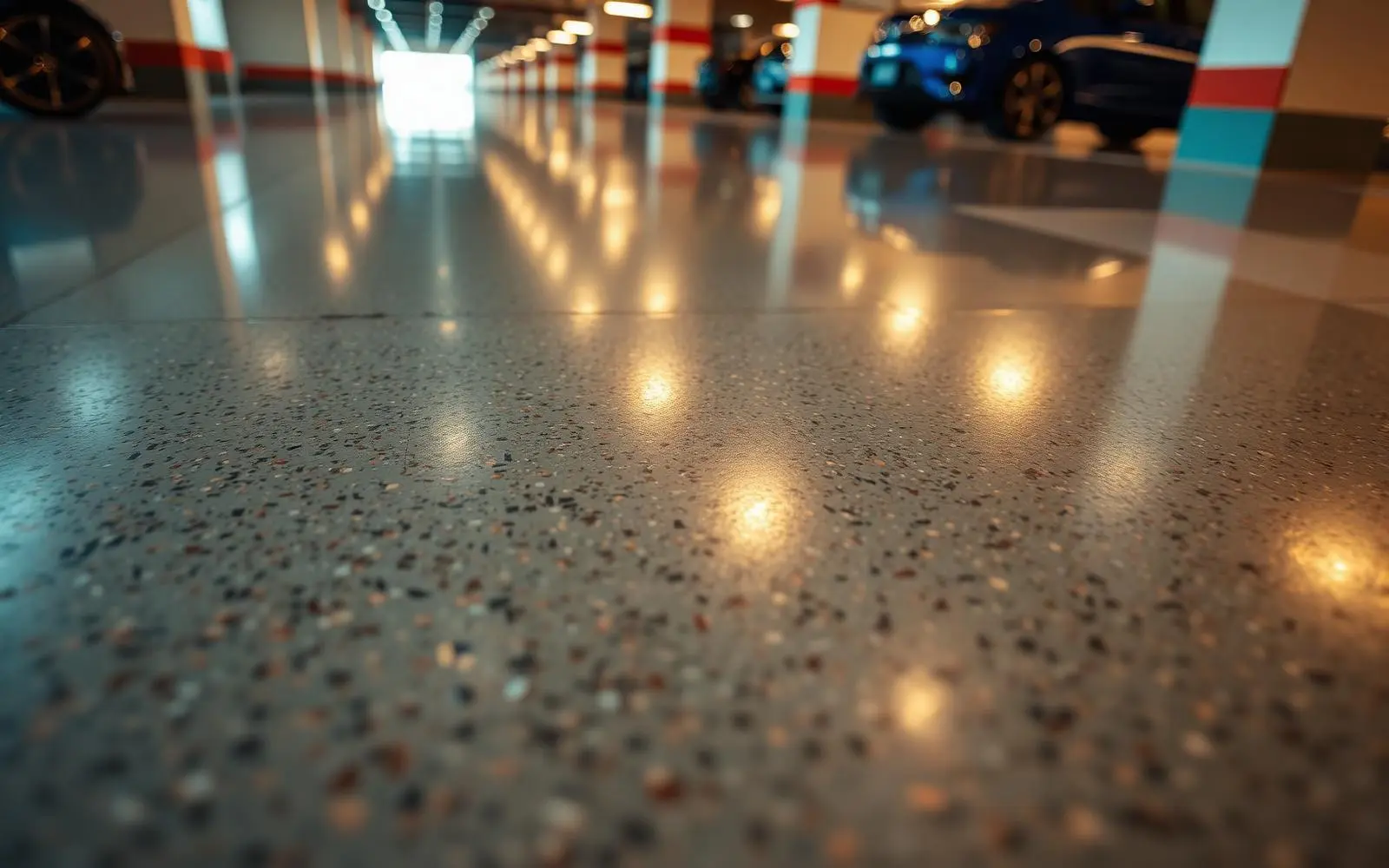
Polyaspartic garage floor with full chip broadcast finish
· Service · 01 / 15

One day in. Driving on it tomorrow.

Polyurea polyaspartic is the flagship single-day garage floor system for Southern California. Aliphatic isocyanate chemistry installs in one day, walks at four hours, accepts vehicles at twenty-four, resists hot-tire pickup, and holds UV stability for 25 years without yellowing.

20+
Years installing
2,400+
Floors completed
5.0 ★
Google rating
10–15 Yr
Written warranty
— TL;DR

The five-second answer.

  • 1-day install. Walk-on at 4 hours, vehicles at 24 hours.
  • Aliphatic isocyanate chemistry — UV-stable, no yellowing for 25+ years.
  • Full vinyl flake broadcast standard; quartz aggregate option for slip-critical zones.
  • 20–40 mil dry-film build. Cost: $8–$12/sq ft installed in SoCal.
  • Flagship residential garage system with transferable 15-year adhesion warranty.
— Definition

What is Polyurea Polyaspartic?

Polyurea polyaspartic is a two-component aliphatic isocyanate / polyaspartic-ester resin system applied as a continuous, fully bonded floor coating. The aliphatic chemistry is what makes it different from cheaper aromatic polyureas: aliphatic resins do not amber under UV, retain Tg (glass transition temperature) above 130 °F, and resist the hot-tire pickup that destroys low-grade epoxies in SoCal garages. Pot life is engineered between 20 and 45 minutes, allowing real-world installation conditions while still curing through hard in 4–6 hours. We install the system at 20–40 mil dry-film thickness — primer, pigmented base, full broadcast media, and aliphatic topcoat — over a slab diamond-ground to ICRI CSP 2–3 and moisture-tested per ASTM F1869.

System specification.

The numbers we'll write into your job file before any product is opened.

Resin
Aliphatic polyurea / polyaspartic ester (2-component)
Mil thickness (dry)
20–40 mil total system build
Layers
Penetrating primer · pigmented base · broadcast media · aliphatic topcoat
Walk-on cure
4–6 hours @ 70 °F
Vehicle-ready cure
24 hours
Full chemical cure
5–7 days
UV stability
25 years — non-yellowing aliphatic
Slip rating (ANSI A326.3 wet DCOF)
0.55–0.65 with broadcast aggregate
VOC content
<100 g/L (CARB SCAQMD compliant)
Warranty
15-year adhesion · transferable residential

Best for.

Where this system outperforms the alternatives. Linked to detailed application pages.

Our install process.

Documented, photographed and signed off step-by-step. Prep is 70% of lifespan.

  1. 01
    On-site spec & moisture test
    Walk substrate, identify expansion joints, run ASTM F1869 calcium chloride and ASTM F2170 RH probes at three locations minimum. Document in job file before any product order.
  2. 02
    Mask & protect
    Adjacent surfaces masked with 2-mil poly and clean tape lines at the threshold. Vehicles, cabinetry and finishes covered.
  3. 03
    Diamond grind to ICRI CSP 2–3
    Planetary grinders with metal-bond tooling produce manufacturer-required surface profile per ICRI Guideline 310.2R. No acid etch.
  4. 04
    OSHA-compliant dust control
    Dust-shroud vacuum on every grinder per OSHA 29 CFR 1926.1153 silica protocol. HEPA-filtered final clean.
  5. 05
    Crack chase & polyurea fill
    Static cracks routed open and filled with 100% solids polyurea, ground flush, color-blended to base coat.
  6. 06
    Penetrating primer
    Low-viscosity polyaspartic primer keys into the open profile and locks the bond line.
  7. 07
    Pigmented base coat
    Base coat rolled to spec mil and immediately broadcast — no second day, no recoat window failure.
  8. 08
    Full broadcast to refusal
    Vinyl flake or quartz aggregate broadcast to refusal across the wet base, scraped and vacuumed.
  9. 09
    Aliphatic topcoat
    Final aliphatic polyaspartic topcoat at full mil build for chemical, UV and abrasion resistance.
  10. 10
    Cure & walkthrough
    Walk-on at 4 hours, vehicles at 24 hours. Printed care kit, batch records and warranty handed off.
— Finish options

Color, texture, depth.

Standard palette includes 18 base colors and 40+ vinyl flake blends from Torginol and proprietary mixes — neutrals (charcoal, granite, taupe, bone) plus statement colors (Newport blue, desert tan, Côte d'Azur). Custom blends matched to vehicle paint, cabinetry or interior tile from sample boards on actual concrete coupons.

[REPLACE: swatch grid — actual finish samples on concrete coupons]

Polyaspartic vs. solid epoxy.

A practical head-to-head — what each system does well, and where the line is.

Recommended

Polyurea Polyaspartic

  • 1-day install, vehicles 24 hr
  • UV-stable aliphatic chemistry
  • Higher elongation — flexes with substrate
  • $8–$12/sq ft installed
Alternative

Solid Epoxy

  • 3–5 day install, vehicles 72 hr
  • Yellows under UV without topcoat
  • Harder, more brittle film
  • $5–$9/sq ft installed

Verdict: Polyaspartic wins for residential garages with UV exposure and any project where downtime matters. Solid epoxy stays the right choice for high-build industrial environments where decorative finish and turnaround take a back seat to film hardness and chemical resistance.

— Frequently asked

Specifics matter.

How long does polyaspartic take to cure?
+
Polyaspartic cures fast: 4–6 hours to walk-on, 24 hours to vehicle traffic, and 5–7 days to full chemical cure at 70 °F substrate temperature. Cooler slabs slow the kick; hotter slabs accelerate it. We adjust catalyst ratio and pot-life on-site rather than push installation outside manufacturer spec. The 24-hour vehicle return is real — not a marketing number — provided substrate temperature stays inside the 50–90 °F window during install.
How long does a polyaspartic garage floor last?
+
A correctly installed aliphatic polyaspartic floor lasts 20–30+ years in SoCal residential service. The wear layer is exceptionally tough; lifespan is governed by surface prep. A diamond-ground slab at ICRI CSP 2–3 with documented ASTM F1869 moisture testing will outlast the home's roof. Floors that fail in the field almost always fail at the bond line — substrate prep — not the topcoat itself.
What does polyaspartic cost per square foot in SoCal?
+
Installed polyaspartic runs $8–$12/sq ft for a standard residential garage in Orange County, LA, San Diego, Inland Empire and Ventura. Pricing reflects diamond grinding, moisture testing, crack repair, primer, pigmented base, full broadcast and aliphatic topcoat. Quotes below $5/sq ft typically skip prep, use aromatic chemistry, or both — and fail inside two summers.
Will polyaspartic yellow in the SoCal sun?
+
No. Aliphatic polyaspartic topcoats are UV-stable and will not yellow or amber. The chemistry to watch is aromatic polyurea — cheaper, common in low-bid quotes, ambers visibly within months of UV exposure. We spec aliphatic-only topcoats from Penntek and Elite Crete on every install. If a competitor's quote does not name the chemistry, assume it is aromatic.
Does polyaspartic resist hot-tire pickup?
+
Yes — aliphatic polyaspartic resists hot-tire pickup permanently when installed over a properly profiled substrate. The resin's Tg (glass transition temperature) sits above 130 °F, well above the bond force a softened tire compound can generate. The other half of the equation is the diamond-ground CSP 2–3 surface profile: an acid-etched or sanded slab gives the coating no mechanical key, and even premium chemistry will lift.
Can polyaspartic be used outdoors in coastal humidity?
+
Yes. Polyaspartic is a strong choice for covered patios, breezeways and outdoor kitchens along the coast. Aliphatic chemistry handles UV and salt-air exposure without ambering or chalking. Direct rain and freeze-thaw are not concerns in SoCal climate. For pool decks specifically we add quartz or polymer aggregate to bring wet DCOF above 0.60 per ANSI A326.3.
Get a Free Estimate

Ready to spec your polyaspartic floor?

Reply within two business hours. On-site consult, written specification, and itemized quote — never a high-pressure sales visit.

(619) 304-6501
Start in 10 seconds

We'll prefill the rest. No spam, no pressure — your details only go to our estimating team.