SoCal Luxury Surfaces
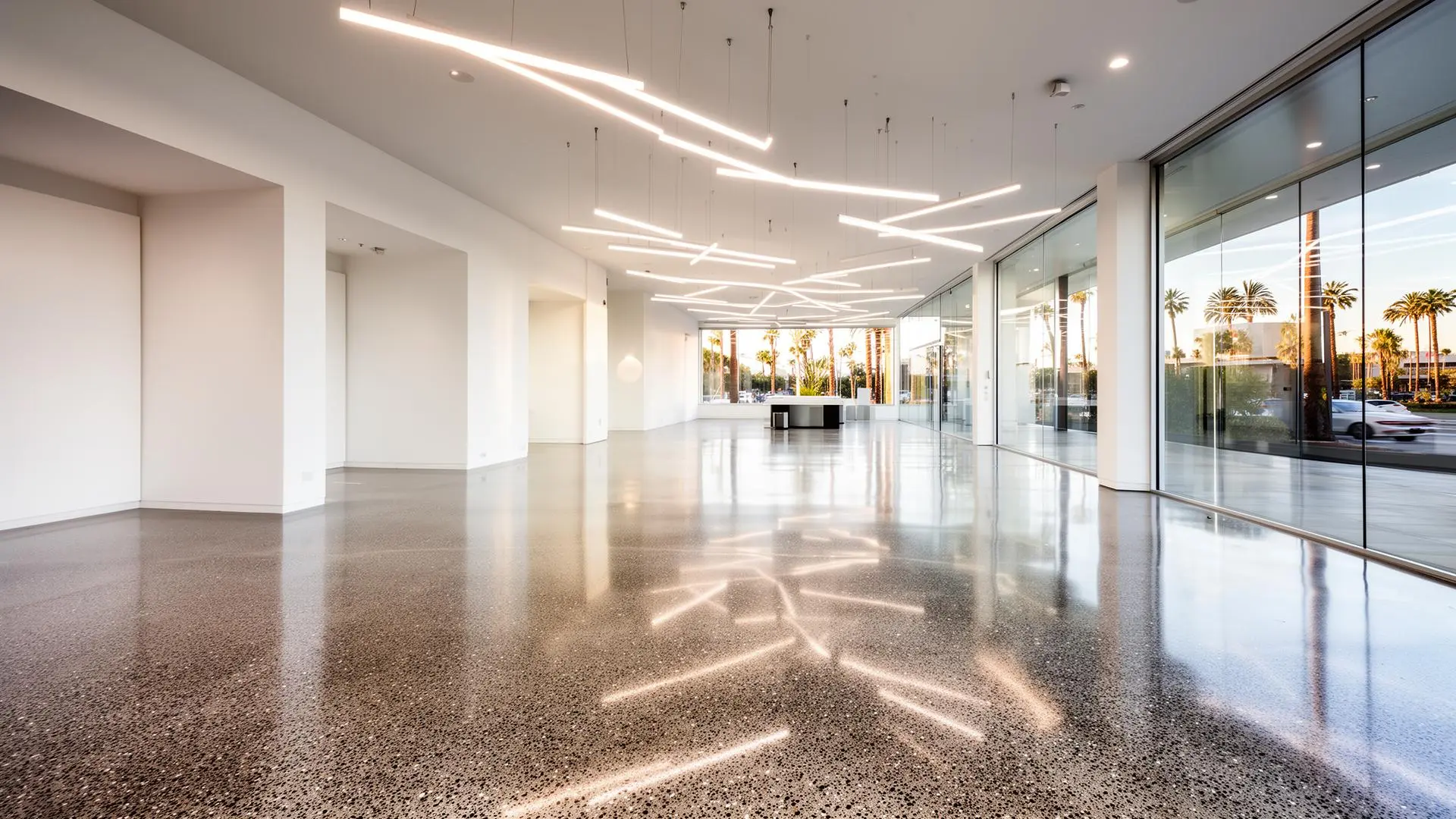
Polished concrete floor with salt-and-pepper aggregate exposure
· Service · 08 / 15

The slab itself, made beautiful.

Concrete polishing is a progressive diamond grind from 30-grit through 3000-grit metal- and resin-bond tooling, densified with lithium or sodium silicate to harden the surface. The result is the existing slab — refined, gloss-tunable through CPAA Levels 1 through 4, with 50+ year life because the floor is the slab.

20+
Years installing
2,400+
Floors completed
5.0 ★
Google rating
10–15 Yr
Written warranty
— TL;DR

The five-second answer.

  • Progressive diamond grind with lithium or sodium silicate densifier.
  • CPAA gloss Levels 1 (400 grit, matte) through 4 (3000 grit, mirror).
  • Cream, salt-and-pepper or full aggregate exposure options.
  • Lifespan: 50+ years (the floor is the slab itself).
  • Cost: $5–$12/sq ft depending on aggregate exposure and gloss level.
— Definition

What is Concrete Polishing?

Concrete polishing is a multi-step mechanical process that transforms an existing concrete slab into a permanent, low-maintenance finished floor. We progress through metal-bond diamonds (30, 70, 120 grit) for cut and aggregate exposure, apply a chemical hardener (lithium or sodium silicate densifier) that reacts with calcium hydroxide in the slab to form additional calcium silicate hydrate (the same compound that gives concrete its strength), then refine through resin-bond diamonds (100, 200, 400, 800, 1500, 3000 grit) to the specified Concrete Polishing Association of America (CPAA) gloss level — Level 1 (matte, 400 grit), Level 2 (satin, 800 grit), Level 3 (semi-polished, 1500 grit) or Level 4 (highly polished, 3000 grit). Aggregate exposure is selected separately: cream finish (no aggregate visible), salt-and-pepper (fine aggregate visible) or full exposure (large aggregate fully revealed).

System specification.

The numbers we'll write into your job file before any product is opened.

Process
Progressive diamond grind 30 → 3000 grit + chemical densifier
Densifier
Lithium or sodium silicate
Gloss levels (CPAA)
Level 1 (400) · 2 (800) · 3 (1500) · 4 (3000)
Aggregate exposure
Cream · Salt-and-pepper · Full aggregate
Color options
Integral / dye / acid stain / chemical stain
Sealer (optional)
Penetrating silicate · topical guard · stain blocker
Slip rating (ANSI A326.3 wet DCOF)
0.42–0.50 (sealer + ceramic additive raises to 0.55+)
VOC content
Effectively zero — mechanical process
Lifespan
50+ years (floor is the slab itself)
Warranty
10-year polish stability + slab life

Best for.

Where this system outperforms the alternatives. Linked to detailed application pages.

Our install process.

Documented, photographed and signed off step-by-step. Prep is 70% of lifespan.

  1. 01
    Substrate evaluation
    Slab evaluated for hardness (Mohs), aggregate type, surface defects, joints and stains. Test patches polished if substrate is unknown.
  2. 02
    Moisture test (ASTM F1869)
    Polishing tolerates wet substrates better than coatings, but moisture history is documented for sealer compatibility.
  3. 03
    Crack and spall repair
    Polyurea crack fill, polymer-modified mortar at spalls — colored to blend with polished surface.
  4. 04
    OSHA silica dust control
    Dust-shroud vacuum and slurry collection per OSHA 29 CFR 1926.1153 — wet polishing on water-tolerant substrates, dry polishing with HEPA on interior.
  5. 05
    Metal-bond diamond cut (30 / 70 / 120 grit)
    Aggressive metal-bond diamonds open the surface and expose aggregate to specified depth.
  6. 06
    Lithium silicate densifier
    Penetrating densifier flooded over open surface, reacts with calcium hydroxide to form CSH — hardens slab permanently.
  7. 07
    Resin-bond polish (100 → 800)
    Resin-bond diamonds refine surface progressively. Each pass removes scratches from the previous.
  8. 08
    Final polish to CPAA target gloss
    Polish through 1500 and 3000 grit if Level 3 or 4 specified. Gloss measured with handheld glossmeter.
  9. 09
    Optional color / sealer
    Acid stain, dye or chemical stain applied between polish steps if specified. Penetrating silicate sealer or topical guard for stain resistance.
  10. 10
    Maintenance plan
    Auto-scrubber dilution, pH-neutral cleaner, burnishing schedule documented. 10-year warranty issued on polish stability.
— Finish options

Color, texture, depth.

Color depends on the existing slab — gray ranges from dove to charcoal. Acid stain palette includes amber, copper, terracotta, sea-foam, English red, black. Dye palette is brighter and more uniform: blacks, blues, greens, golds. Sample boards on actual project slab before any color commitment.

[REPLACE: swatch grid — actual finish samples on concrete coupons]

Polished concrete vs. epoxy coating.

A practical head-to-head — what each system does well, and where the line is.

Recommended

Polished Concrete

  • 50+ year life — the floor IS the slab
  • Effectively zero VOCs (mechanical)
  • Recoatable and re-burnishable
  • $5–$12/sq ft
Alternative

Epoxy or Polyaspartic Coating

  • Decorative options far broader
  • Hides slab defects under film
  • Recoat / replace cycle 15–25 yr
  • $5–$14/sq ft

Verdict: Polished concrete wins for sound substrates with 50+ year horizon and minimal maintenance burden — and where the existing slab is the design feature. Coatings win where the substrate is compromised, where decorative depth or color is the goal, or where chemical / impact resistance must be higher than concrete itself can deliver.

— Frequently asked

Specifics matter.

What does polished concrete cost per square foot?
+
Polished concrete runs $5–$12/sq ft in SoCal — the floor of the range is Level 1 cream finish (400 grit, no aggregate exposure, no color); the top is Level 4 mirror finish (3000 grit) with full aggregate exposure and acid stain. Pricing reflects substrate condition, gloss level, color treatment and overall square footage. Large commercial floors (5,000+ sq ft) drop to the lower end of the range.
How long does polishing take?
+
A 1,000 sq ft polish runs 3–4 days: cut + densify (Day 1), polish to 400 (Day 2), polish to 800 (Day 3), final polish + color/sealer (Day 4). Larger floors scale linearly. We work in operational facilities by zoning the project — polished sections go back to use within 24 hours of the final pass.
What gloss level should I choose?
+
CPAA Level 2 (800 grit satin) is the most common choice for residential and hospitality — refined, light-reflective without being mirror-bright. Level 3 (1500 grit) is the auto-dealership / luxury retail standard. Level 4 (3000 grit mirror) reads as a true polished floor — striking but shows footprints and water spots more readily. Level 1 (400 grit matte) is an industrial / casual aesthetic.
Can polished concrete handle wet conditions?
+
Polished concrete sits at wet DCOF 0.42–0.50 (ANSI A326.3) — borderline for wet residential, below standard for commercial wet zones. We add a ceramic-bead additive into the topical guard sealer to bring wet DCOF above 0.55. For showers, pool surrounds and wet-process commercial we recommend epoxy quartz or urethane cement instead.
Does polished concrete need to be sealed?
+
Optional. The lithium silicate densifier hardens the slab and substantially reduces porosity, but unsealed polished concrete will still stain from oils and acids over time. We recommend a penetrating silicate stain blocker for residential and a topical urethane or polyaspartic guard for commercial. Sealer choice affects gloss — we sample on the project slab first.
Can you polish a slab that already has a coating?
+
Yes — coating must be removed first. We diamond-grind through the existing coating to bare concrete, then begin the polishing sequence. Removal adds $2–$4/sq ft depending on coating type and thickness. Floors that were thin-coated or stained previously sometimes polish through to a beautiful natural finish; heavily epoxied floors require more aggressive removal.
Get a Free Estimate

Ready to polish the floor you already own?

Reply within two business hours. On-site consult, written specification, and itemized quote — never a high-pressure sales visit.

(619) 304-6501
Start in 10 seconds

We'll prefill the rest. No spam, no pressure — your details only go to our estimating team.