Surface Prep Standards Explained: CSP, ICRI 310.2R, and Why Your Floor Will Fail Without Them
Almost every premature floor failure I'm called to inspect comes down to one root cause: the slab was never properly profiled. A beautiful resin system bonded to an unprepared slab is a beautiful resin system that will release in three years.
The industry has a published standard for this — ICRI 310.2R, which defines Concrete Surface Profile (CSP) levels 1 through 9. Understanding what those numbers mean, and which one your floor system requires, is the single most important thing a buyer or specifier can know.
- ·ICRI 310.2R defines nine CSP levels, from CSP 1 (acid-etched smooth) to CSP 9 (heavy scarification).
- ·Most resin floor systems require a CSP between 2 and 4 — achieved by diamond grinding or shot blasting, never by acid etching alone.
- ·Acid etching is not a substitute for mechanical prep. It cannot meet the CSP requirement of any modern high-build resin manufacturer.
- ·If your installer can't tell you the target CSP for your system, they don't know enough to install it.
What CSP actually measures
Concrete Surface Profile is a measurement of how rough the prepared concrete surface is. ICRI sells a set of nine rubber comparator chips that physically replicate each CSP level — installers run a thumb across the chip, then across the prepared slab, and match the texture. It is not a guess; it is a tactile, repeatable standard.
A higher CSP number means a rougher profile, which means more mechanical surface area for the resin to grip. The relationship is not linear — a CSP 3 has roughly 50% more bonded surface area than a CSP 1.
Which CSP your system needs
Different resin systems require different profiles. Get this wrong and the floor either delaminates (profile too smooth) or telegraphs the prep marks through the finish (profile too aggressive).
- 01Penetrating sealers and densifiers: CSP 1 (light grind or screen)
- 02Thin-film coatings under 10 mils (most polyaspartic chip systems): CSP 2–3
- 03Self-leveling overlays (4–10 mm): CSP 3–5
- 04High-build epoxy mortars and urethane cements (10+ mm): CSP 5–9
Why acid etching fails
Acid etching uses muriatic or phosphoric acid to react with the cement paste and create a surface texture. In theory it sounds reasonable; in practice, three things go wrong.
First, acid etching almost never produces a profile above CSP 1, which is below the minimum for any modern high-build resin. Second, residual acid and salts left behind interfere with resin bonding even after rinsing. Third, acid does not cut through curing compounds, sealers, or contamination — it just eats around them, leaving inconsistent bonding zones. Every major resin manufacturer's data sheet now explicitly excludes acid etching from acceptable prep methods.
How proper prep is actually done
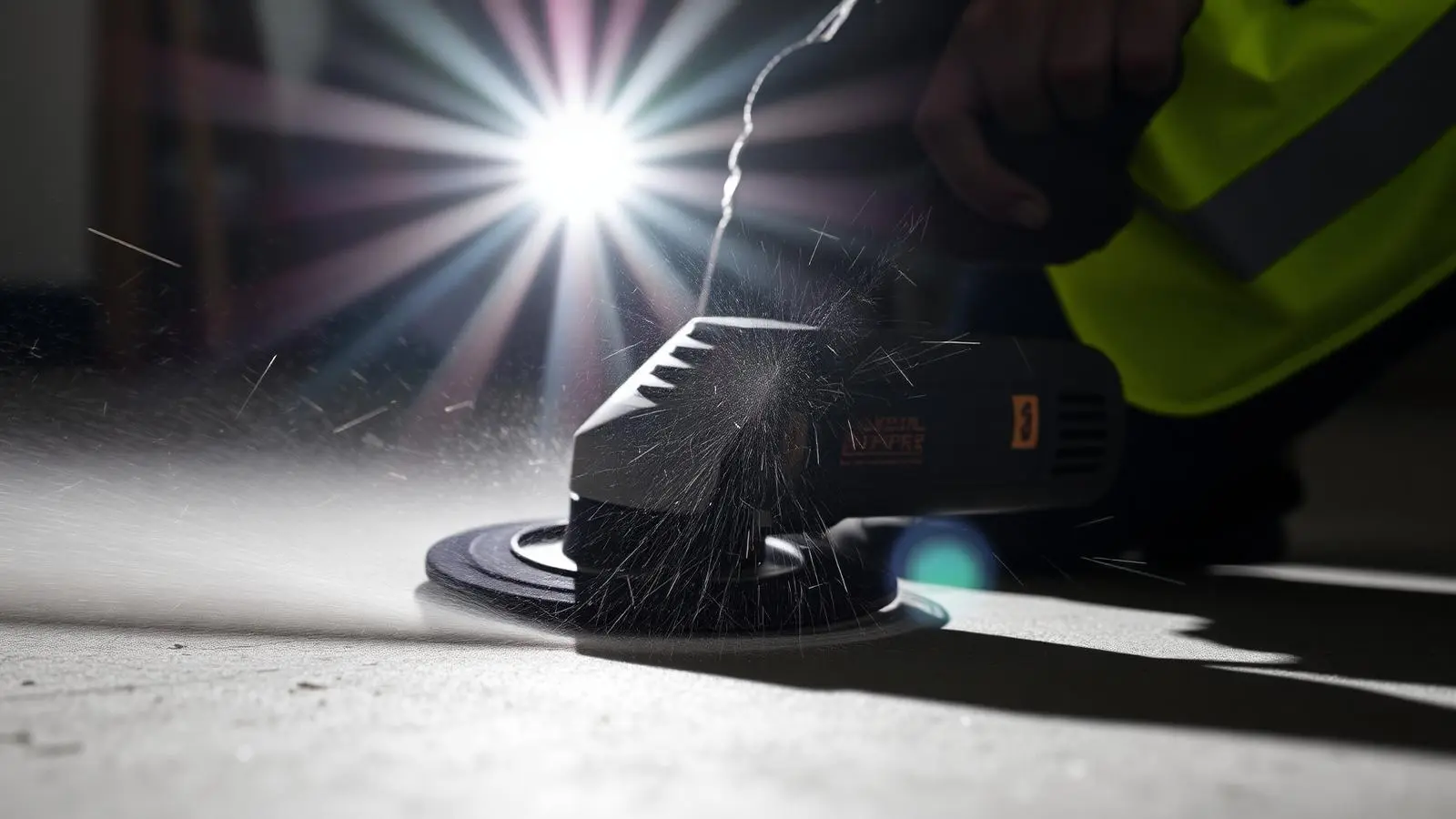
Mechanical prep is the only acceptable method for any resin floor that needs to last. The two real tools:
- 01Diamond grinding — Walk-behind or ride-on planetary grinders with metal-bonded diamond tooling. Produces a controlled CSP 2–4 profile and removes 1–3 mm of laitance and contamination.
- 02Shot blasting — Steel shot is propelled at the slab in a sealed enclosure, then vacuumed back. Produces CSP 4–6 profiles, removes deeper contamination, and is the standard for industrial floors and large overlay projects.
What to ask your installer
Three questions will tell you everything you need to know about whether an installer understands prep:
Edge cases — when more prep is required
Slabs with previous coatings, heavy oil contamination, or chemical staining often need a multi-step prep: shot blast first to break up the contamination, then diamond grind to refine the profile and remove the steel shot residue. Skipping the second step leaves a profile that's too aggressive and causes pinholes in the finished resin.
Slabs with high moisture vapor emission (above 3 lbs/1000 sq ft/24 hr by ASTM F1869) require a moisture mitigation primer regardless of the resin system. No amount of profiling will save a floor that has water pushing up from underneath.
Frequently asked questions
Can I see the CSP profile before the floor is poured?
Yes. A reputable installer will walk the slab with you after grinding, show you the ICRI comparator chips, and have you confirm the profile matches the system's spec sheet before any resin is mixed.
Does CSP matter for polished concrete?
No — polished concrete is the slab itself, not a coating, so CSP standards don't apply. The polish progression (30, 80, 200, 400, 800, 1500, 3000 grit) is its own measurement system.
What happens if the CSP is too aggressive for a thin coating?
The grind marks telegraph through the finished resin, especially under raking light. The floor functions normally but visually looks like an unfinished industrial surface rather than a designer floor.

Moisture Testing in Southern California: Why ASTM F1869 and F2170 Decide Whether Your Floor Survives
A practical explanation of moisture testing for resin floor systems in Southern California — when each test is required, what the numbers mean, and why coastal slabs almost always need a moisture mitigation primer.

Metallic Epoxy vs. Polyaspartic: Which Floor Belongs in a Southern California Garage?
A field-tested comparison of metallic epoxy and polyaspartic floor systems for Southern California garages — durability, UV behavior, cost, install timeline, and resale value.

Garage Floor Coating Cost in San Diego: A 2025 Buyer's Guide
What a professional garage floor coating actually costs in San Diego in 2025 — line-item pricing, what drives the price up or down, and how to read a quote without getting ambushed by upsells.
Ready to specify your floor?
Reply within two business hours. On-site consult, written specification, and itemized quote — never a high-pressure sales visit.
(619) 304-6501