SoCal Luxury Surfaces
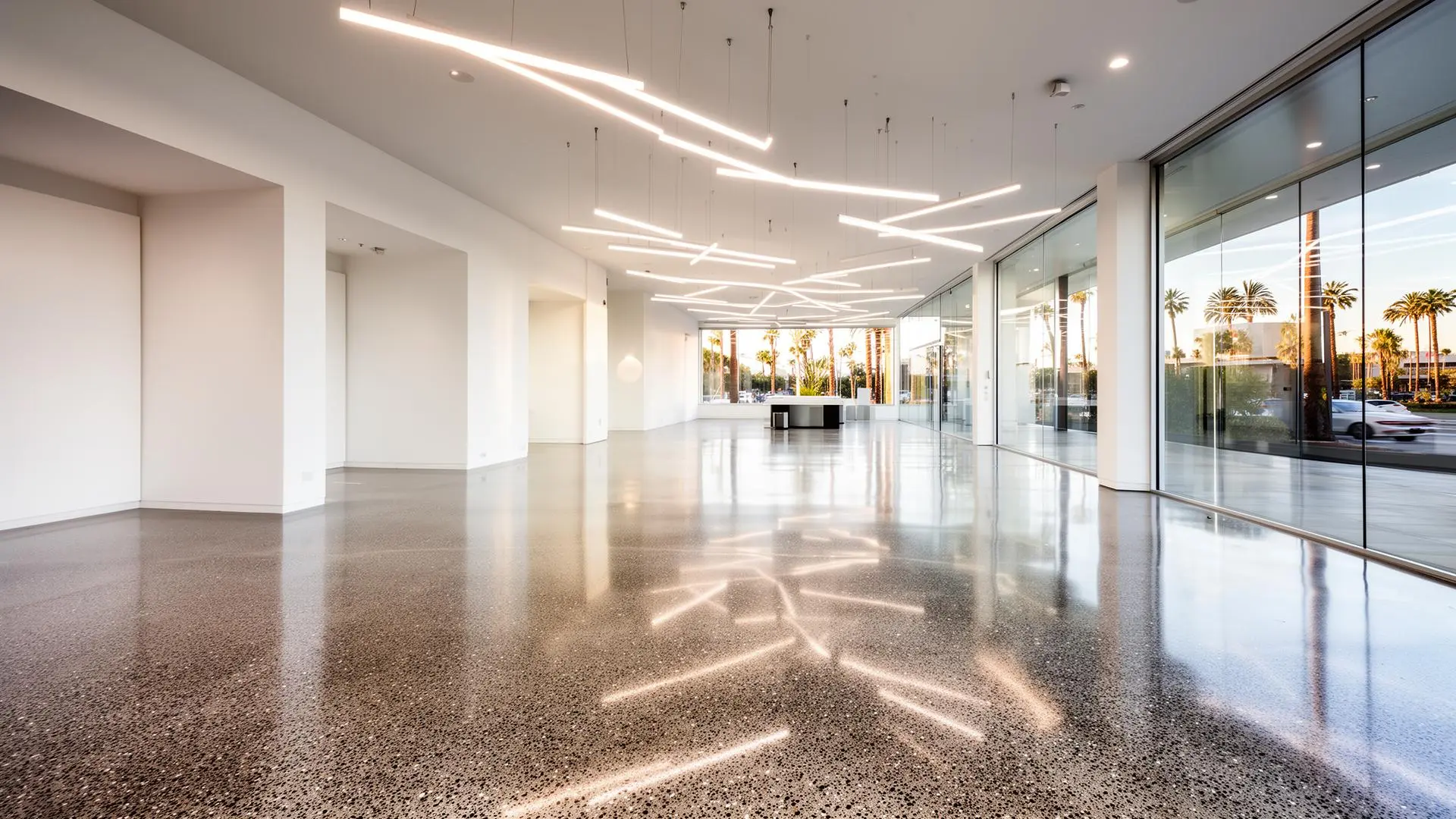
Self-leveling concrete topping over existing slab
· Service · 14 / 15

Flat. True. Polishable.

Self-leveling concrete is a polymer-modified cementitious underlayment poured at quarter-inch to two inches thick to true an existing slab to F35+ flatness. The base for finish flooring (LVP, tile, polish), and a polishable decorative topping in its own right. $4–$10/sq ft installed across SoCal.

20+
Years installing
2,400+
Floors completed
5.0 ★
Google rating
10–15 Yr
Written warranty
— TL;DR

The five-second answer.

  • Polymer-modified cementitious underlayment, 1/4 to 2 inch thick.
  • Flatness to F35+ — substrate for tile, LVP, hardwood or polish.
  • Decorative topping accepts polish, dye and stain.
  • Cost: $4–$10/sq ft installed.
— Definition

What is Self-Leveling Concrete?

Self-leveling concrete is a cementitious underlayment formulated with polymer modifiers (acrylic, latex, SBR) to flow flat under gravity and bond to a primed substrate. Mixed at high water ratios for fluidity, pumped or poured, and spike-rolled to release entrained air, the system self-levels to F-number flatness above F35 — the standard for tile, LVP, hardwood and finish-flooring underlayment. Decorative self-leveling toppings are formulated for surface durability and accept polish, dye, stain and integral color, becoming the finish floor itself rather than an underlayment. Walk-on at 4 to 12 hours, finish-flooring installation at 24 to 72 hours, polish at 7 to 14 days.

System specification.

The numbers we'll write into your job file before any product is opened.

Resin / binder
Polymer-modified portland cement (acrylic / SBR / latex)
Thickness range
1/4 inch to 2 inches (6 mm to 50 mm)
Flatness target
F35+ (FF35 / FL25 typical)
Walk-on cure
4–12 hours
Finish flooring install
24–72 hours after pour
Polishable cure
7–14 days
Compressive strength
4,000–6,500 psi at 28 days
Slip rating (sealed, ANSI A326.3 wet DCOF)
0.42–0.55
VOC content
<50 g/L
Warranty
10-year underlayment adhesion

Best for.

Where this system outperforms the alternatives. Linked to detailed application pages.

Our install process.

Documented, photographed and signed off step-by-step. Prep is 70% of lifespan.

  1. 01
    Substrate evaluation
    Slab evaluated for slope, flatness deviation, prior coatings and bond strength. F-number measurement establishes baseline.
  2. 02
    Crack and joint detail
    Static cracks chased and filled; expansion joints honored through pour (will telegraph if not honored).
  3. 03
    Diamond grind to ICRI CSP 3
    Aggressive surface profile required for underlayment bond per ICRI 310.2R.
  4. 04
    Polymer primer
    Polymer-modified bond primer rolled at full coverage to lock underlayment-to-substrate.
  5. 05
    Form perimeters and openings
    Threshold dams, drain protection and edge forms set to control pour.
  6. 06
    Pump or pour underlayment
    Self-leveling material pumped or poured in continuous lift to spec thickness.
  7. 07
    Spike-roll for air release
    Spike-roller pulled across wet pour to release entrained air and ensure full bond at substrate.
  8. 08
    Cure & sand if polishing
    Cure 24 hr for finish flooring, 7+ days for polish. Light surface grind opens decorative topping for polish sequence.
— Finish options

Color, texture, depth.

Underlayment use is invisible — covered by finish flooring. Decorative topping accepts integral pigment, dye and acid stain palettes — refer to Concrete Polishing and Acid Staining pages for color options.

[REPLACE: swatch grid — actual finish samples on concrete coupons]

Self-leveling vs. mud-set float.

A practical head-to-head — what each system does well, and where the line is.

Recommended

Self-Leveling Underlayment

  • F35+ flatness in one pour
  • 4–12 hour walk-on
  • Polishable decorative topping option
  • $4–$10/sq ft
Alternative

Hand-Floated Mortar Bed

  • Skill-dependent flatness
  • Cure 24–48 hr before next trade
  • No polishable surface
  • $3–$7/sq ft

Verdict: Self-leveling wins anywhere finish-flooring installers need true flatness fast — tile, LVP, hardwood. Hand-floated mortar still works for shower pans and one-off slope details where self-leveler is the wrong tool.

— Frequently asked

Specifics matter.

What does self-leveling concrete cost?
+
Self-leveling installs at $4–$10/sq ft in SoCal. Pricing depends on thickness (1/4 inch at the floor of the range, 1–2 inch deeper pours at the top), substrate prep, and whether the system is underlayment (covered by finish flooring) or decorative topping (polished or stained as the finish floor). Pump-truck pours on larger projects (3,000+ sq ft) drop to the lower end.
How thick can self-leveling go?
+
Standard self-leveling underlayments pour at 1/4 to 1 inch in a single lift. Special-formulation deep-pour self-levelers go to 2 inches. Beyond 2 inches we recommend conventional concrete or two-lift self-leveling pours separated by full cure. Thinner than 1/4 inch is feather-edge territory — risks lifting at the edge, not recommended.
How fast can finish flooring go down on top?
+
Tile and LVP can install at 24 hours after pour with proper acclimation. Hardwood and engineered wood require longer drying — 72 hours minimum, sometimes longer in coastal humidity. Polished finishes require full cure (7–14 days) before grinding. We coordinate with the finish-flooring installer to sequence trades correctly.
Can self-leveling concrete be used as the finished floor?
+
Yes — decorative self-leveling toppings are formulated specifically for surface durability and accept polish, dye and acid stain. The result is a polished concrete finish without the variability of an existing slab — colors are more uniform, surface is dense and the polish takes evenly. We pour at 3/8 inch minimum for polishable toppings, allow full 14-day cure before polish sequence.
Will self-leveling crack along old slab cracks?
+
Static cracks that have been chased and filled with polyurea before pour generally do not telegraph. Active cracks WILL telegraph — for those substrates we either elastomeric-isolate the crack with a soft joint detail or recommend other systems. Expansion joints are honored through the pour; ignoring them guarantees cracking at the joint location.
Is self-leveling concrete waterproof?
+
No — self-leveling cementitious underlayment is permeable. For waterproofing applications (showers, decks over occupied space, exterior decks) we install a separate waterproofing membrane (sheet membrane or liquid-applied) before or after the self-leveler depending on system. Self-leveler alone is not a waterproofing layer.
Get a Free Estimate

Ready to true your slab the right way?

Reply within two business hours. On-site consult, written specification, and itemized quote — never a high-pressure sales visit.

(619) 304-6501
Start in 10 seconds

We'll prefill the rest. No spam, no pressure — your details only go to our estimating team.