SoCal Luxury Surfaces
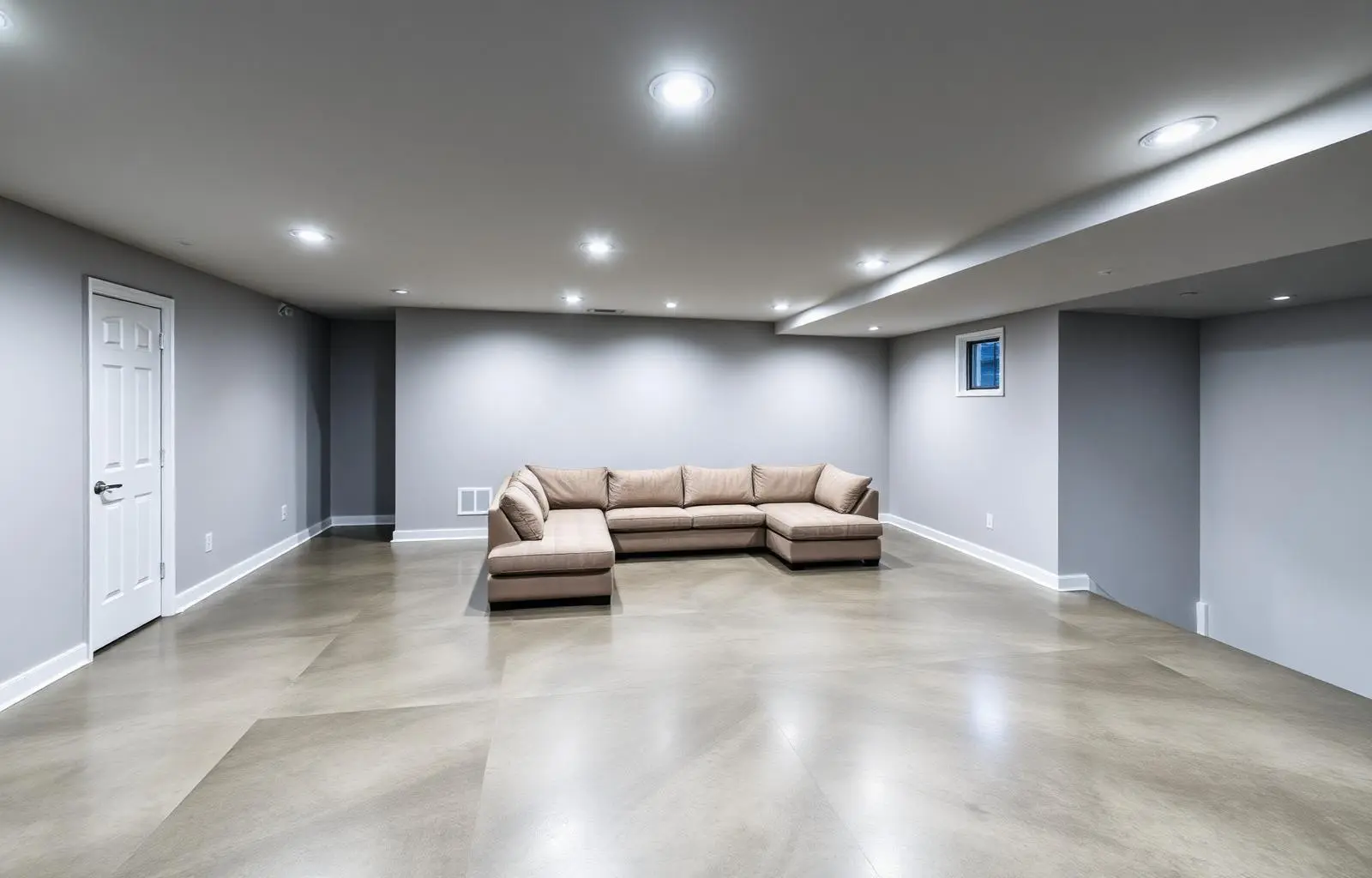
Finished basement with polished concrete floor
· Residential · Basements

The slab below grade always wins. Unless you test it.

Below-grade slabs in SoCal almost always have moisture vapor drive — the question isn't whether, but how much. A coating installed without ASTM F1869 / F2170 testing on a 5+ lb slab will blister and delaminate inside 18 months, every time.

20+
Years installing
2,400+
Floors completed
5.0 ★
Google rating
10–15 Yr
Written warranty
— TL;DR

The five-second answer.

  • Cost $5–$14/sq ft installed.
  • Moisture testing (ASTM F1869 calcium chloride, ASTM F2170 RH) before any coating spec.
  • Mitigation primer required when MVER exceeds 3 lbs / 1000 sf / 24 hr.
  • Polished concrete is moisture-tolerant by design — often the right answer for damp basements.
— The problem

Moisture is what kills basement coatings.

A below-grade slab is in constant contact with subgrade moisture. Water vapor moves up through the slab continuously, and a vapor-impermeable coating (most epoxies) becomes a one-way membrane that traps that vapor at the bond line. Within 12–18 months: blistering, delamination, white efflorescence at the seal line. The fix is testing first (ASTM F1869 calcium chloride or ASTM F2170 in-situ RH probes), then either specifying a moisture-tolerant system (polished concrete, breathable sealer) or installing a vapor-mitigating epoxy primer rated for the measured MVER before the finish coat goes down.

What we engineer around.

Substrate, environment, downtime — every spec gets evaluated before product is selected.

Moisture vapor drive

ASTM F1869 calcium chloride or ASTM F2170 in-situ RH testing required before spec. Non-negotiable below grade.

Hydrostatic pressure

Standing water on the slab post-rain indicates active hydrostatic pressure — that's a waterproofing job, not a coating one.

Substrate temp & dew point

Concrete temp must be 5°F above dew point at install. Cold basements in winter need acclimation.

Lighting & sheen

Below-grade lighting is rarely abundant; we spec higher-sheen finishes (semi-gloss to gloss) to reflect the available light.

Crack and joint plan

Static cracks chased, control joints filled with semi-rigid epoxy or polyurea — not left to telegraph.

Indoor air quality

Low-VOC and zero-VOC chemistry available for finished living spaces; respirator-required products avoided.

— Typical timeline

2–4 days for polished concrete; 3–5 days for moisture-mitigated polyaspartic or metallic.

— Typical cost range

$5–$14/sq ft. Polishing on the low end; metallic + mitigation primer on the high end.

Final spec quoted on-site after substrate evaluation.

— Frequently asked

Specifics matter.

Why do basement floors need a moisture test?
+
Below-grade concrete is in continuous contact with subgrade moisture. Vapor moves up through the slab whether you can see it or not. A coating installed without testing the moisture vapor emission rate (MVER) will trap that vapor at the bond line and blister. ASTM F1869 (calcium chloride dome) and ASTM F2170 (in-situ RH probes) are the two standard tests. We run F1869 minimum on every basement; F2170 when MVER comes in elevated and we need a deeper read.
What's the MVER threshold?
+
Most coating manufacturers rate their products to a maximum MVER, typically 3 lb / 1000 sf / 24 hr (calcium chloride). Above that, a vapor-mitigating epoxy primer is required between substrate and finish. These primers are rated to 12–25 lbs depending on product. We test, document the result, and either certify the slab is in spec or quote the mitigation primer line item — never assume.
Can I have polished concrete in a damp basement?
+
Often yes — polishing is one of the most moisture-tolerant systems available. Densifier penetrates and reacts with the cement, and the surface stays breathable. The slab still vents moisture upward, but there's no film to blister. We'll still measure MVER for the project file, but a properly polished basement slab handles a moderate moisture load that would destroy a film-forming coating.
Can you do metallic epoxy in a basement?
+
Yes — metallic epoxy in a basement bar, theater, or wine cellar is a stunning install. The non-negotiable is moisture testing first. If MVER is above the manufacturer's rating, we install a vapor-mitigating primer rated for the measured load before the metallic basecoat. Skipping this step is what produces the metallic floors that bubble in year two — installer ignored the substrate.
How long is install with mitigation primer?
+
Add roughly 24 hours to the standard install timeline. Mitigation primer goes down day one, cures overnight, and the standard system installs on top starting day two. The primer adds material cost ($1.50–$3 / sq ft) but is the difference between a 25-year floor and a one-year floor on a wet substrate.
Get a Free Estimate

Ready to spec your basement?

Reply within two business hours. On-site consult, written specification, and itemized quote — never a high-pressure sales visit.

(619) 304-6501
Start in 10 seconds

We'll prefill the rest. No spam, no pressure — your details only go to our estimating team.