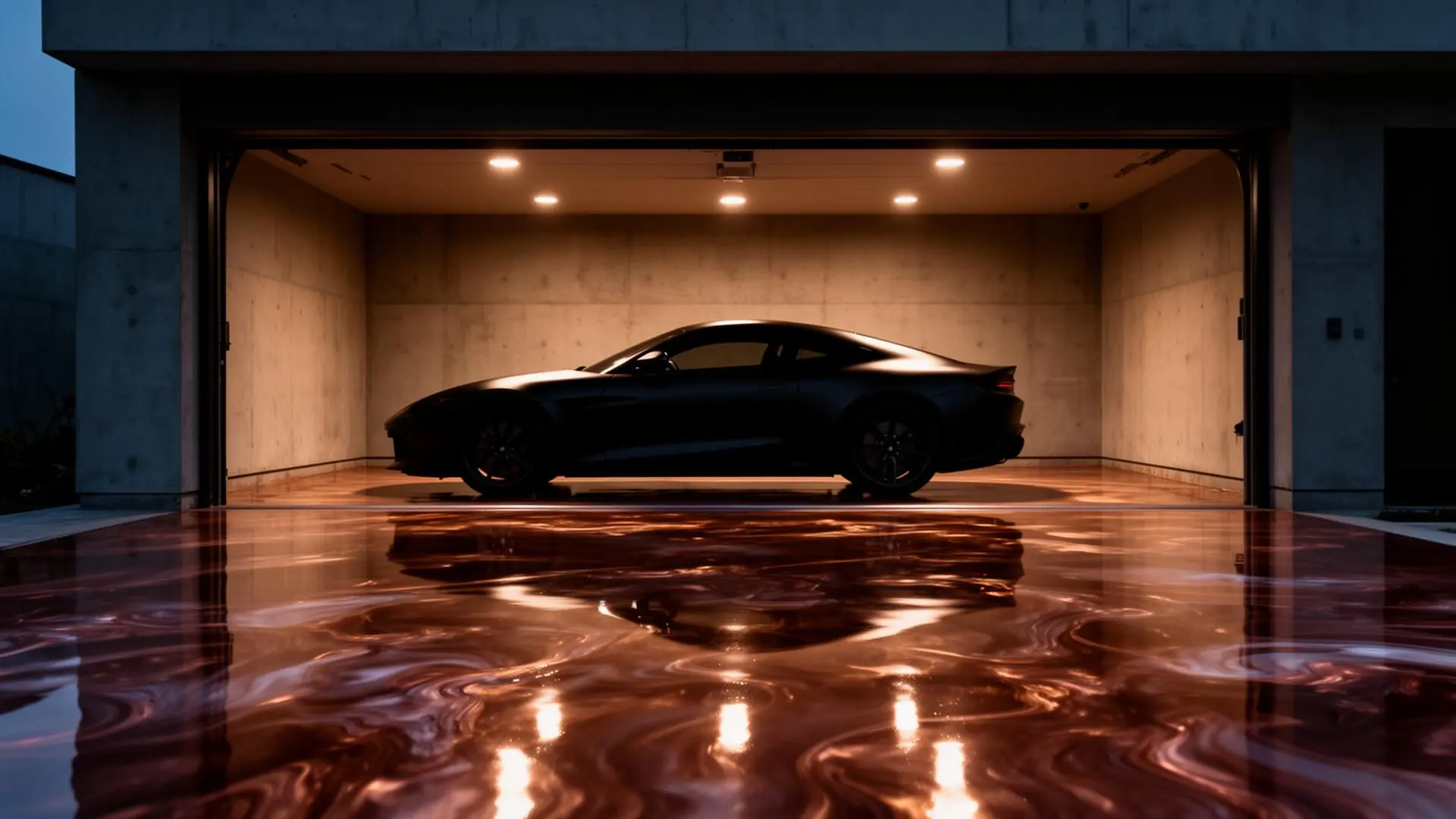
A driveway in Southern California fights UV, hot tire transfer, oil staining, salt air and 30°F daily thermal swing — the surface either gets engineered for that or it fails inside two seasons..
Three engineered options. Final selection drives off your substrate, use and decorative goal.
Penetrating silicate or silane/siloxane — invisible, freeze-thaw safe, 5–15 yr.
Stampable overlay over sound substrate — full decorative restoration without tear-out.
Polyaspartic with quartz broadcast for slip — UV-stable, hot-tire-resistant.
Substrate, environment, downtime — every spec gets evaluated before product is selected.
Polyaspartic and silane sealers resist; cheap acrylics and aromatic epoxy will lift with hot rubber.
Ventura and SD coastal slabs need silane/siloxane impregnation to block chloride ingress.
Aggregate broadcast (quartz or silica) brings DCOF to 0.6+ where slope or rain pooling is in play.
Existing crack inventory dictates joint plan; static cracks are chased and filled before any topical.
Pre-existing oil must be degreased and shot-blasted; coating over an oily substrate fails at the bond line.
1–3 days for sealer or polyaspartic. 3–5 days for stampable overlay including cure.
$2–$12/sq ft installed. Penetrating sealer at the low end; decorative overlay at the high end.
Final spec quoted on-site after substrate evaluation.
Last updated: April 2026
Reply within two business hours. On-site consult, written specification, and itemized quote — never a high-pressure sales visit.
(619) 304-6501